Chase Login: Sign In to Online Banking and the Mobile App
Quick answer: Open chase.com in your browser, find the Sign in box at the top right, type your username and password, then select Sign in. On your phone, open the Chase Mobile app and use Face ID, Touch ID, or fingerprint. If the sign-in box asks you to confirm a one-time code, approve it to finish.
That one box handles almost everything. Your Chase login works the same whether you bank, pay a card, or check an auto loan, so there is no separate door for each product. If you cannot remember your details or the page will not let you in, the sections below walk through every fix, step by step, in plain language.
A quick note before you start. This is an independent help guide from ClinMed Journals. It is not a Chase page, it has no login form on it, and it will never ask for your username, password, or any code. The only place you should ever type your Chase login is the real chase.com website or the official Chase Mobile app.
Which Chase login do you need?
People often think a Chase bank login, a Chase credit card login, and a business login are three different things. For most customers they are not. One set of credentials signs you in to all the Chase accounts tied to your profile. Here is how it breaks down.
| You want to... | Where to sign in | Login used |
|---|---|---|
| Check a checking or savings account | chase.com or the Chase Mobile app | Your personal Chase online username and password |
| Pay or view a Chase credit card | chase.com or the Chase Mobile app | The same personal login (the card shows under your accounts) |
| Manage a Chase for Business account | chase.com Sign in box | Your business online banking username and password |
| Use J.P. Morgan Wealth investing | chase.com or the Chase Mobile app | Your Chase login, with investments shown alongside bank accounts |
If you hold both personal and business accounts, you may have two separate logins, since Chase keeps business profiles distinct from personal ones. Everything else usually lives behind a single Chase.com login. When in doubt, start at the main Sign in box and the right accounts appear once you are in.
How to sign in on the Chase website
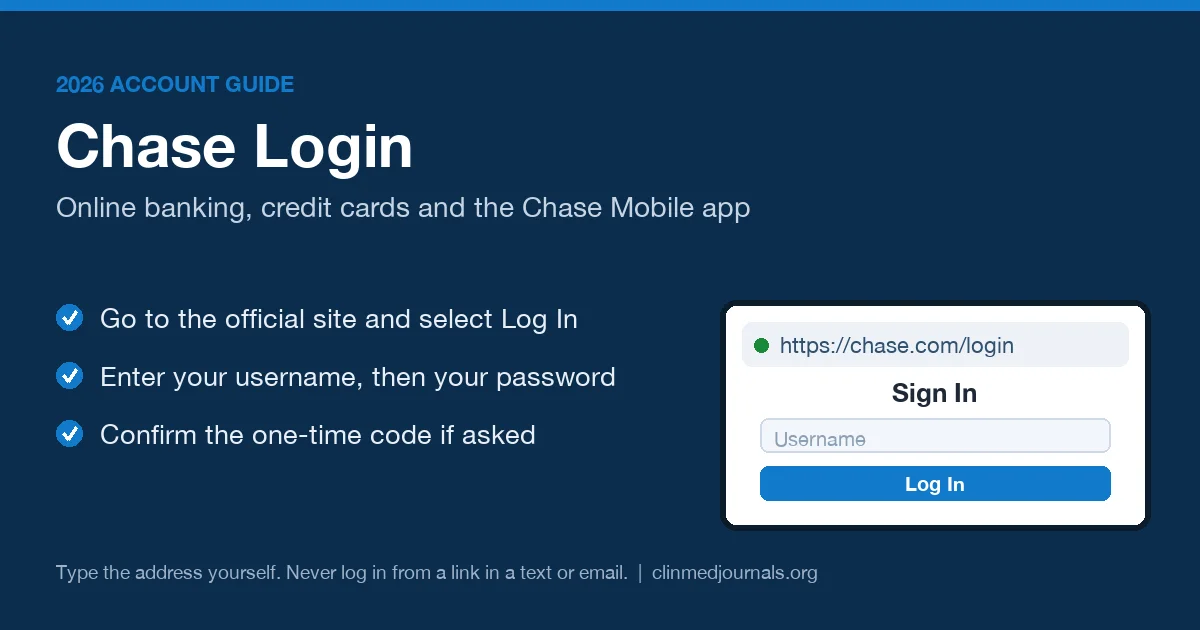
Signing in to Chase online from a computer takes about a minute. Follow these steps.
- Type chase.com straight into the address bar yourself, or use a bookmark you saved earlier. Avoid links in emails or texts.
- Check that the address reads www.chase.com and that your browser shows a padlock for a secure connection.
- Look to the top right of the page for the Sign in box. It has two fields, Username and Password.
- Enter your username, then your password. You can select Show Password to make sure you typed it correctly.
- Tick Remember username if this is your own device, so you only type the password next time.
- Select Sign in.
- If Chase asks you to verify it is really you, it sends a one-time code or a prompt. Enter the code or approve the request to reach your accounts.
Chase also offers a Passwordless sign in option on chase.com. If you have set up a passkey, you can sign in with your device unlock instead of typing a password. Passkeys and password managers both work on the site, so pick whatever you find easier.
How to sign in on the Chase Mobile app
The Chase Mobile app is the fastest way to bank from a phone or tablet. It is available for both iPhone and Android. To get it, open Apple's App Store or Google Play and search for Chase Mobile, then install the official app published by JPMorgan Chase.
Once the app is installed, sign in like this.
- Open the Chase Mobile app.
- Enter your username and password the first time, the same ones you use for Chase.com login.
- When prompted, turn on Face ID, Touch ID, or fingerprint login. The app supports all three.
- After that, a glance or a touch signs you in, so you rarely type your password again on that phone.
- If the app shows a 2-step verification prompt, approve it or enter the code it sends.
Inside the app you can view balances and recent transactions, deposit checks with your camera, pay bills, send money with Zelle, set alerts, see statements, and message customer support. It is the same account you reach on the website, just built for a smaller screen.
Reset your username or password
Forgot your sign-in details? You do not need to call anyone. The Sign in box has a Forgot username/password? link right below the password field. Here is what to do.
- Go to chase.com and select Forgot username/password? under the Sign in box.
- Tell Chase whether you need your username, your password, or both.
- Confirm your identity. Chase typically asks for details it already has on file and sends a one-time code to your phone or email.
- Enter the code, then create a new password or view your username.
- Sign in with the updated details.
Pick a password you do not use anywhere else, and store it in a password manager if you can. If you would rather skip passwords altogether, set up a passkey after you sign back in, so future logins use your device unlock.
Chase login not working? Find your fix
Most sign-in trouble comes down to a handful of causes. Match your symptom to the table, then try the fix.
| Problem | Likely cause | What to try |
|---|---|---|
| Password rejected | Caps Lock on, old password, or a typo | Use Show Password to check it, then reset it with Forgot username/password? if needed |
| Verification code never arrives | Code is going to an old phone number or email | Update your contact details after you sign in, or call Chase to refresh them first |
| Account is locked | Too many failed attempts | Wait a short while, then reset your password to unlock, or call customer service |
| Website loads but will not sign in | Browser cache or an extension is interfering | Clear your cache, try a private window, or use a different browser |
| App will not open or sign in | Outdated app version | Update the Chase Mobile app from the App Store or Google Play, then try again |
| Everything fails at once | Possible temporary outage | Try the app if the site fails, or wait a few minutes and retry |
One more thing worth knowing. If Chase spots unusual activity, it may place a temporary hold and ask you to verify yourself before you can get back in. That is a safety feature, not a glitch. Approve the check or call the number on the back of your card to clear it.
New to Chase? Register for online access
If you have a Chase account but have never used Chase online, you enroll once and then your Chase bank login is ready. You will need your account details handy.
- Go to chase.com and select Not Enrolled? Sign Up Now near the Sign in box.
- Enter the account information Chase asks for to confirm you own the account.
- Create a username and a strong password.
- Add a phone number and email so Chase can send verification codes and alerts.
- Finish setup, then sign in with your new details on the website or in the Chase Mobile app.
Credit card holders enroll the same way. Once you are set up, your Chase credit card login and your bank login are the same, and both cards and accounts show in one place.
Security and spotting fake Chase sites
Chase builds real protection into online and mobile banking. Knowing what is genuine makes it easy to ignore the fakes.
- Chase encrypts your information when you sign in to chase.com or the Chase Mobile app.
- On a first sign-in, or when something looks unusual, Chase adds an extra check such as an app notification or a one-time code. This is 2-step verification.
- The mobile app offers Face ID, Touch ID, and fingerprint login, so you can keep your password off the screen.
- Zero Liability Protection covers unauthorized card charges when you report them promptly, and Chase monitors card purchases around the clock.
- Chase Credit Journey gives free identity monitoring with alerts for dark web findings, data breaches, and credit report changes.
Scammers copy the Chase look to steal logins. Protect yourself with a few habits.
- Type chase.com yourself or use your own bookmark. Do not sign in through a link in an email or text.
- Check the address bar reads www.chase.com before you type anything. A close copy like a hyphen or an extra word is a red flag.
- Chase will not ask for your full password or a one-time code by email, text, or phone call. If someone does, it is a scam.
- Forward suspicious emails that claim to be from Chase to phishing@chase.com, then delete them.
- When in doubt, contact Chase using the number on the back of your card before you share anything or send money.
Chase customer service numbers for login help
If you have tried the steps above and still cannot get in, a person can help. These are Chase customer service lines. Use the one that fits your account, and remember Chase will never ask for your full password when you call.
| Help with... | Phone number |
|---|---|
| Personal banking, plus online and mobile banking support | 1-800-935-9935 |
| Chase credit cards | 1-800-432-3117 |
| Chase for Business customer service | 1-800-242-7338 (1-800-CHASE38) |
| Business banking from outside the United States | 1-713-262-3300 |
| Lost or stolen card | Use the number on the back of your card, or replace it after you sign in |
| Auto loans and leases | 1-800-336-6675 |
| Home lending (mortgage and home equity) | 1-800-848-9136 |
| J.P. Morgan Wealth Management investing | 1-800-392-5749 |
| Military services (domestic) | 1-877-469-0110 |
| Military services (overseas) | 1-318-340-3308 |
You can also message support inside the Chase Mobile app once you are signed in, which is handy for account questions that are not urgent.
Chase login on desktop vs mobile browser
The Chase login works in any modern browser, but the screen looks a little different by device. Knowing where the Sign in box sits saves time.
On a desktop or laptop, the Sign in box sits in the top right of chase.com, with the Username and Password fields together. The full menu runs across the top, so you can jump to credit cards, auto, or home lending before or after you sign in.
On a phone browser, the page shrinks to fit. The Sign in link often hides behind a menu button, usually three lines in a corner, or shows as a Sign in button near the top. Tap it and the same two fields appear. Anything you can do on the desktop site you can do here too, it just scrolls more.
The browser route needs no download and works on a borrowed computer. The Chase Mobile app, by contrast, adds Face ID, Touch ID, and fingerprint sign-in, plus mobile check deposit. If you bank from your own phone every day, the app is quicker. For a one-off sign-in on someone else's device, the browser is the safer pick.
Sign in with a passkey (passwordless)
Chase supports passkeys on chase.com, so you can skip the typed password altogether. A passkey lets you sign in using your face, your fingerprint, or your device passcode instead. Chase says a passkey cannot be guessed or leaked, and it is very hard to steal, which makes it safer than a password you reuse.
To start, sign in the normal way once, then look for the Set up passkey option in your security settings. Follow the prompt to create the passkey on the device you are using. After that, the next sign-in on that device uses your unlock method rather than a password.
chase.com is also password manager enabled, so if you would rather keep a saved password in a trusted manager, that works too. Passkeys and password managers can sit side by side. Pick whichever you find simpler, and keep your old password as a backup until you are comfortable.
Turn on Face ID, Touch ID, or fingerprint sign-in
Biometric sign-in is the fastest way into the Chase Mobile app. You set it up once inside the app.
- Sign in to the Chase Mobile app with your username and password.
- Tap the Profile & Settings icon in the top right corner.
- Tap Sign-in preferences.
- Select Face ID & Passcode on an Apple device, or Fingerprint sign in on an Android device.
- Toggle the switch on.
From then on, a glance or a touch opens the app. Your face and fingerprint data stay on your phone, not with Chase. If you get a new phone, set it up again on the new device.
Set up two-step verification
Two-step verification adds a one-time code on top of your password, so a stolen password alone will not get anyone in. You can set it to run every time you sign in on a browser. Here is the path on chase.com.
- Sign in to chase.com and select the Security & Privacy tab at the top. On some accounts you choose Security, then Manage security & privacy.
- Find the Enhance your Security section under My Account.
- Choose to enable 2-step verification for extra security at sign-in.
- Turn on Use 2-step verification every time you sign in on a browser.
- If you want, also turn on Receive one-time codes by email, so a code can reach you two ways.
- Confirm to save.
You can also mark a phone as a trusted device with the Enroll device option in the Chase Mobile app. A trusted device adds a layer of protection even if someone has part of your information.
Chase account alerts and sign-in notifications
Alerts tell you the moment something happens on your account, which is one of the fastest ways to catch a login you did not make. You can add account alerts in the Chase Mobile app or on chase.com, under your security and alert settings.
Set alerts for the events that matter to you, such as a new sign-in, a password change, a large purchase, or a low balance. If an alert ever shows activity you did not do, change your password straight away and call the number on the back of your card.
For any alert or code to reach you, your contact details must be current. Check your phone number and email after you sign in, especially if you have switched carriers or changed your email, so a verification code never lands on an address you no longer use.
Send money with Zelle after you sign in
Once you are signed in, Zelle lets you send money to friends and family straight from your Chase account. You enroll once, then sending takes seconds. An eligible Chase checking account is required, and savings accounts cannot be used to enroll.
To enroll in the Chase Mobile app, tap Pay & Transfer, then Send money with Zelle, then Get started. Accept the terms if asked, pick your account, add an email or U.S. mobile number, and enter the one-time code Chase sends to confirm it.
To send after you are enrolled, tap Pay & Transfer, then Send money with Zelle, choose or add the person, enter the amount and the account to use, then review and send. When the person you are paying is already enrolled with Zelle, the money is typically available in minutes. Some transfers can take up to 3 business days.
Chase for Business vs personal login
Business and personal banking use separate profiles at Chase, so they are the main case where you might hold two logins. The good news is both sign in from the same Sign in box at chase.com.
If you are an existing customer, you can sign in with either your Business Banking or your Personal Banking username and password. A business checking signer can link personal accounts to the business profile, which lets you move money between personal and business accounts with one user ID and password.
Two things are worth remembering for a business login. First, entering the password incorrectly three times in a row blocks access to Chase Business Online, so reset it with Forgot Username/Password rather than guessing again. Second, the Chase Mobile app takes your Chase Business Online username and password and runs an extra identity check the first time you sign in.
Logging in while travelling abroad
Your Chase login works overseas the same way it does at home, as long as you have internet. The website and the Chase Mobile app both load on a foreign connection, though some banking features can depend on where you are.
Two steps make travel smoother. Keep your contact details current before you leave, because a verification code is no help if it goes to a number you cannot reach abroad. Chase no longer accepts travel notices for most accounts, and instead suggests you set account alerts in the app or on chase.com to watch activity while you are away.
Be mindful of money, not just access. Depending on your account type, foreign currency transaction fees can apply when you use your debit card or pull cash from an ATM outside the United States. Your card keeps round-the-clock fraud monitoring and zero liability for unauthorized transactions you report promptly, wherever you are.
If your account is locked or restricted
A locked or restricted account is usually Chase protecting you, not a fault at your end. Match the cause to the fix below.
- Too many failed sign-ins. Wait a short while, then reset your password with Forgot username/password, which often clears the lock. Business Online blocks access after three wrong password tries, so reset rather than keep guessing.
- Unusual activity. If Chase spots something odd, it may place a temporary hold and ask you to verify yourself before you get back in. Approve it, or clear it by phone using the number printed on your card.
- Old contact details. If the verification step cannot reach you, you can be stuck out. Call the number for your account so Chase can confirm your identity and refresh your phone and email.
In every case, a real person on the right customer service line can lift the block once you prove who you are. Chase will never ask for your full password when you call.
Frequently Asked Questions & Answers (FAQS):
It is chase.com. Type www.chase.com into your browser yourself, or use the Chase Mobile app. Avoid signing in through links in emails or texts, since those are common in scams.
For most customers, yes. One personal Chase login signs you in to your bank accounts and your Chase credit cards. After you enroll once, both show up together when you sign in.
You can do either. The full Chase online banking site works in any browser on a computer or phone. The Chase Mobile app simply adds quick sign-in with Face ID, Touch ID, or fingerprint and tools like mobile check deposit.
It lets you sign in to chase.com with a passkey, using your device unlock instead of a typed password. You set it up after signing in. Chase also supports password managers if you prefer the classic way.
The code is probably going to an old phone number or email. Update your contact details after you sign in. If you cannot get in at all, call the number for your account so Chase can refresh your information.
A lock usually follows too many failed attempts. Wait a short while, then reset your password with the Forgot username/password? link, which often clears the lock. If it does not, call customer service.
Not always. A wrong password, a browser issue, or an expired app version causes most errors. Try the Chase Mobile app if the website fails, or clear your browser cache. If both fail, wait a few minutes and try again.
Send any email that claims to be from Chase but looks wrong to phishing@chase.com, then delete it. If a message feels off, phone Chase on the number printed on your card before you act on it.
Sign in to the Chase Mobile app, tap the Profile & Settings icon in the top right, then tap Sign-in preferences. Choose Face ID & Passcode on an Apple device or Fingerprint sign in on Android, and toggle it on. After that, a glance or a touch signs you in.
You can once you have enrolled. In the Chase Mobile app, tap Pay & Transfer, then Send money with Zelle, and follow the one-time setup. An eligible Chase checking account is required. After that, sending takes seconds, and the money is usually available in minutes when the recipient is already enrolled with Zelle.
For most accounts, no. Chase no longer accepts travel notices and suggests you set account alerts in the app or on chase.com instead. Just keep your phone number and email current before you leave, so any verification code can reach you overseas.
Not usually. Business and personal banking use separate profiles, so you may have two logins. Both sign in from the same box at chase.com, and a business checking signer can link personal accounts to the business profile to manage them with one user ID and password.
Sources
- Chase home page and Sign in box (chase.com)
- Chase Mobile app (download, features, Face ID / Touch ID / fingerprint)
- Chase customer service phone numbers
- How Chase protects you (encryption, 2-step verification, fraud protection)
- Chase Security Center: report fraud and suspicious emails (phishing@chase.com)
- How you can protect yourself (passkeys, 2-step verification, biometric sign-in, trusted device, alerts)
- How to enroll in and use Zelle in the Chase Mobile app
- Chase Business Online banking support (business vs personal sign-in, linking accounts)
- Chase for Business contact numbers
- Chase on travel notices and setting account alerts when travelling
ClinMed Journals is not affiliated with, endorsed by, or sponsored by JPMorgan Chase Bank, N.A. This guide is for general information only and is not financial advice. Always confirm login steps and account details on the official chase.com website or the Chase Mobile app.