
Richter’s hernia is a rare subtype of femoral hernia in which only the antimesenteric portion of the bowel wall becomes incarcerated, potentially leading to ischemia and perforation without complete luminal obstruction. We present the case of a 90-year-old woman with hypertension who developed abdominal distension, pain, and intolerance to food. On admission, she was found to have signs of bowel obstruction and a right inguinal incarcerated hernia. Surgical exploration revealed a right-sided Richter’s femoral hernia with a 2 cm perforation in the small intestine, located 40 cm from the ileocecal valve. Resection and end-to-end anastomosis were performed, and the hernia defect was repaired with a polypropylene mesh. The postoperative course was initially favorable, but the patient subsequently developed community-acquired pneumonia and died 10 days later due to respiratory complications. This case highlights the importance of early recognition and individualized surgical management of Richter’s hernia, especially in elderly patients with increased risk of morbidity and mortality.
Richter’s hernia, Femoral hernia, Intestinal obstruction, Geriatric surgery, Emergency laparotomy, Bowel perforation
Femoral hernia represents a protrusion of intra-abdominal contents through the femoral canal due to a defect in the transversalis fascia. Although it accounts for only 2-4% of all groin hernias, it is more common in females and has a high risk of strangulation-up to six to eight times higher than inguinal hernias. Richter’s hernia is a unique and rare presentation in which only the antimesenteric wall of the bowel is incarcerated, increasing the risk of ischemia and perforation without classic symptoms of complete obstruction [1]. Early diagnosis and urgent surgical intervention are essential, particularly in older patients who are at increased risk of complications.
A 90-year-old female with a 10-year history of hypertension presented to the emergency department with five days of abdominal distension, increasing pain, absence of bowel movements, and intolerance to food. On physical examination, she exhibited signs of intestinal obstruction and a painful, irreducible mass in the right inguinal region. She was taken to the operating room with a presumptive diagnosis of incarcerated inguinal hernia and intestinal obstruction.
Intraoperatively, a Richter’s femoral hernia was identified on the right side [2,3]; containing a loop of small bowel with a 2 cm perforation located 40 cm from the ileocecal valve (Figure 1). Resection of the affected segment was performed with a primary end-to-end anastomosis. The hernia defect was repaired with a polypropylene mesh in a sublay position [4]. A Penrose drain was placed in the pelvic cavity. The patient tolerated the procedure well, with initial postoperative stability. However, during the postoperative course, she developed community-acquired pneumonia, requiring antimicrobial therapy. Despite appropriate management, the patient died 10 days postoperatively due to respiratory complications.
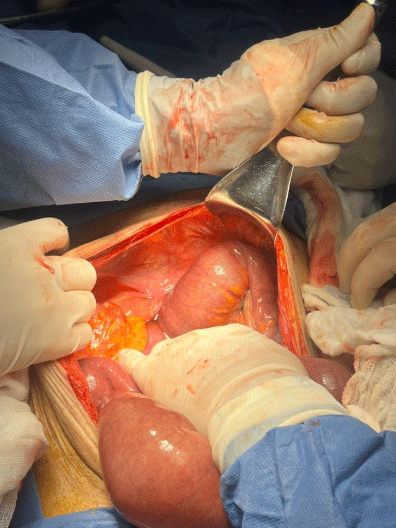 Figure 1: Intraoperative view showing distended small bowel and hernia sac protruding through femoral canal.
View Figure 1
Figure 1: Intraoperative view showing distended small bowel and hernia sac protruding through femoral canal.
View Figure 1
Richter’s hernia is often diagnosed at a complicated stage, frequently requiring emergency surgery (Figure 2) [5]. The use of mesh in contaminated fields remains controversial, especially in elderly patients with comorbidities. In our case, the decision to perform bowel resection, primary anastomosis, and mesh repair was based on intraoperative findings and the patient’s initial stability (Figure 3 and Figure 4). While the surgical outcome was technically successful, postoperative complications ultimately led to a fatal outcome, underscoring the fragility of elderly patients with complex surgical conditions.
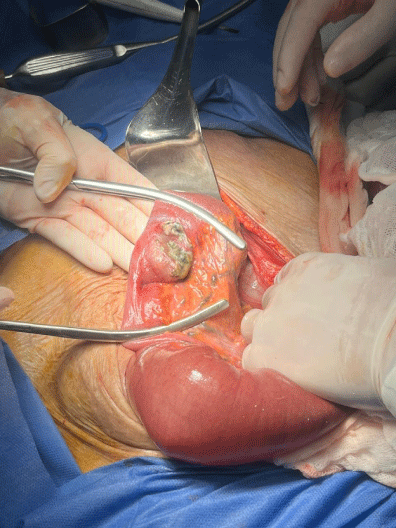 Figure 2: Necrotic antimesenteric border of the small intestine within the femoral hernia (Richter’s hernia).
View Figure 2
Figure 2: Necrotic antimesenteric border of the small intestine within the femoral hernia (Richter’s hernia).
View Figure 2
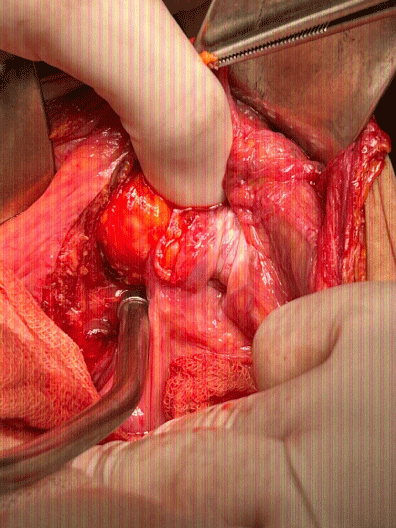 Figure 3: Resected bowel segment and femoral hernia defect being prepared for mesh repair.
View Figure 3
Figure 3: Resected bowel segment and femoral hernia defect being prepared for mesh repair.
View Figure 3
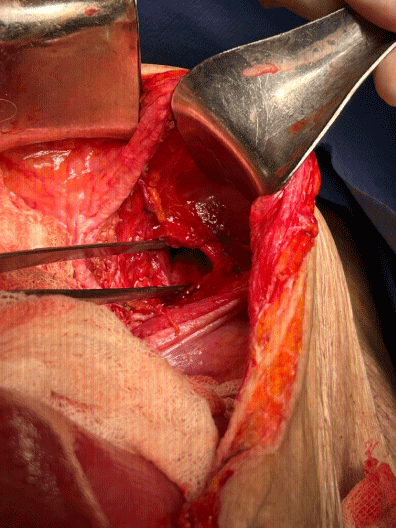 Figure 4: Exposed femoral canal following resection and before mesh placement.
View Figure 4
Figure 4: Exposed femoral canal following resection and before mesh placement.
View Figure 4
This case illustrates the clinical challenge posed by Richter’s hernia in geriatric patients. Despite being a rare entity, its potential for severe complications, including bowel perforation, mandates early recognition and urgent individualized surgical intervention. Multidisciplinary perioperative management is essential in optimizing outcomes, particularly in patients with advanced age and comorbid conditions.
Written informed consent was obtained from the patient’s next of kin for publication of this case report and accompanying images.
The authors declare no conflicts of interest.
No funding was received for this study.