This paper analyzes the complex association between the stringency of restrictions, public mobility, and reproduction rate (R-value) on a national level for Germany. The main findings are that: i) Government restrictions have a high association with reduced public mobility, especially for non-food stores and public transport; ii) Out of six measured public mobility, retail, recreation, and transit station activities have the most significant impact on COVID-19 reproduction rates; iii) A mobility reduction of 30% is required to have a critical negative impact on case number dynamics, preventing further spread.
Sars-COV2 virus, Pandemic response, Machine learning, Public health, Mobility measures
The COVID-19 virus first appeared in China in December 2019 and spread rapidly around the world. The World Health Organization (WHO) declared it a Public Health Emergency of International Concern in January 2020 and as a pandemic on March 11 [1]. As of the end of July 2024, it had cost 7.1 million lives worldwide [2,3]. The airborne nature of the virus meant that it was imperative to ensure that infected persons spread it to as few others as possible. The pivotal average number of other individuals that each carrier of the virus infects at a given point in time is defined as the reproduction value (R-value) [4,5]. The goal of lowering the R-value made it essential to reduce close contact between individuals, and most policy responses targeted social distancing and public mobility reduction. This was pursued through various means by national governments [6,7]. Various countries or specific regions around the world have placed a wide variety of mobility restrictions to protect their populations from being infected. An international review of government interventions found that a combination of measures implemented at the right points in time was essential for curbing reproduction numbers [8]. A comprehensive global meta-analysis on R-values worldwide ranged from 0.48 to 14.8 [9]. The R-value below 1 is recommended as ideal to effectively reduce epidemic numbers and stop the virus from spreading [10].
General compliance with these policies could be estimated by observing the amount of traffic at public spaces of various kinds [11,12]. For example, the current mobility could be measured through automated data collection implemented on a variety of platforms [13]. This allows for an estimate of the number of people passing at certain locations and is usually presented as daily aggregates.
Due to the variety in responses and reporting, the present study concentrates on the effects of policy implementation in a single country and uses Germany as a case study for the dependencies between public policy, aggregate mobility, and virus contamination. According to the WHO, there were 19.9 million cases and 128,000 deaths in Germany through March 26, 2022. There were several national "lockdown" periods in Germany with a combination of measures from the list enforced by work-at-home orders, mandatory closures of public and private establishments, and travel restrictions [14].
This study focuses on the associations between restrictions, public mobility and viral reproduction. The government response is related to loss of mobility and the spread of infections through a combination of correlation analyses and a machine learning technique (Gaussian Process Regression). The inferential measures are complemented by an estimation of a threshold level of mobility required for keeping the R-value below 1, i.e., containing further viral dissemination. In this context, the contributions of the present study can be summarized as follows. First, the relationship between stringency measures and mobility is quantified, highlighting which sectors of public life are most impacted by public restrictions. Second, the correlation between various mobility patterns and virus spread is analyzed, identifying which types of mobility most significantly affect the reproduction number. Finally, the study utilizes machine learning to analyze the effects of mobility, vaccinations, and temperature on virus spread, establishing a threshold to contain the further spread of infections.
Restrictions on the movements of the public reduced the spreading of COVID-19 spreading in many countries [15]. Stay-at-home orders were the most effective restriction in reducing mobility and reducing COVID-19 cases, while mask mandates had minimal impact [16]. The influence of social distancing was studied by Shearston, et al. [11] on pedestrians in New York, concluding that there was a sharp drop in traffic jams early on, while after 2 months before cancelling of restrictions the traffic jams increased again. There is a known effect of fatigue from social distancing leading to lower respect for restrictions by increasing traffic even before cancelling restrictions [11]. The same results on fatigue of social distancing states Hoeben, et al. [12] also found that weather has a strong effect on rule violations. In the case of Germany, Anke, et al. [17] argue that the pandemic had a profound impact on mobility behaviour with new tendencies to use less public transportation (buses, trains) and increasing usage of cars, transportation by walking or bicycle, regarding lockdown measures.
The efficiency of restriction measures can be quantified as to their isolated effect on reducing the R-value, and the most successful stringency measures appear to have been based on the premise of reducing human-to-human contact [18]. In general, numbers below 1 show a reduction of spreading viruses and greater than 1 indicate epidemic growth [19]. For example, it has been identified that reductions in air, car, public and pedestrian travel had a strong association with falling R numbers [20] and that especially transport and workplace activity reductions were paramount for the reduction of community infection [21,22]. The predictive power of mobility alone as a determinant of Sars-COV2 transmission has been found to range between 30 and 80%, depending on the level of other applied restrictions [6].
The nonlinear nature and influence of external factors in the relationship between mobility and virus transmission make modelling their interaction a complex task. While several conventional statistical approaches have been attempted [23-25], previous research shows indications that Gaussian Process Regression (GPR) models form a solid basis for models of virus spread [26,27]. In direct csomparisons between the methods on COVID-19 data, GPR has been able to fit the data better than other machine learning methods like Support Vector Machines (SVM) or Decision Trees (DT) [28]. Due to its capacity to capture spatiotemporal variations combined with external factors, it can be considered the state of the art for modelling the geographical spread of diseases. This has been found also in other diseases such as malaria [29]. GPR seems to work well with small to moderate-sized datasets as in the COVID-19 pandemic (daily observations over slightly more than a year). Gaussian Process Regression (GPR) is a nonparametric supervised machine learning method usually applied to multivariate classification and regression problems [30]. GPR is used for describing the original distribution for flexible classification and regression models, where regression or class probability functions are not only simple parametric forms. One of the main advantages of the Gaussian process is the diversity of covariance functions that leads to the formation of functions with distinct types or degrees of continuous structures and enables the proper selection.
An exponential-logarithmic model has been identified as an adequate fit for the association between community mobilities and reproduction rates [31], i.e. the logarithm of the R-value is dependent on aggregate mobility. It has also been identified that both temperature and level of vaccinations have an impact on reproduction [32,33].
Dependent variables: Google Mobility [1] utilizes data from the Google Maps system and other platforms and measures the amount of mobility in the six categories presented in Table 1. The numbers are reported as the percentage change from a baseline level in February 2021.
Table 1: Public mobility data categories. View Table 1
Independent variables: The government level of restrictions is quantified in a project known as the Oxford COVID-19 Government Response, operated by the Blavatnik School of Government at the University of Oxford. It incorporates a wide variety of different restrictions related to social distancing in the wake of the pandemic and serves as a benchmark on how much each administration enforced lockdown. The Stringency Index is a weighted average of several categories [34], including school closures, workplace closures, cancellation of public events, restrictions on public gatherings, closures of public transport, stay-at-home requirements, public information campaigns, restrictions on internal movements, and international travel controls. R-values were obtained from the Robert Koch Institute derived from a now-casting model which has been used to forecast virus propagation on national and local levels [35]. Through time series analysis of the number of new cases per day, an instantaneous reproduction number can be derived retrospectively for each day [36]. Temperature data were collected from the German Weather Service (DWD). The daily average at the Berlin-Tegel station was used as an aggregate for each day in the studied period.
Mobility correlation: Spearman correlations were used to identify associations between:
a) Oxford Stringency Index and the various mobilities
b) Mobilities and reproduction values
Gaussian process regression: A GPR model for the relationship between mobility, temperature, and vaccinations with an exponential kernel with a scale of 14.396 and a signal standard deviation: of 0.230.
The Oxford Stringency Index calculates stringency as a weighted index of government response related to nine
factors. Estimated levels of stringency of German policy are on display in Figure 1, on a scale from 0 (no restrictions) to 100% (maximum lockdown).
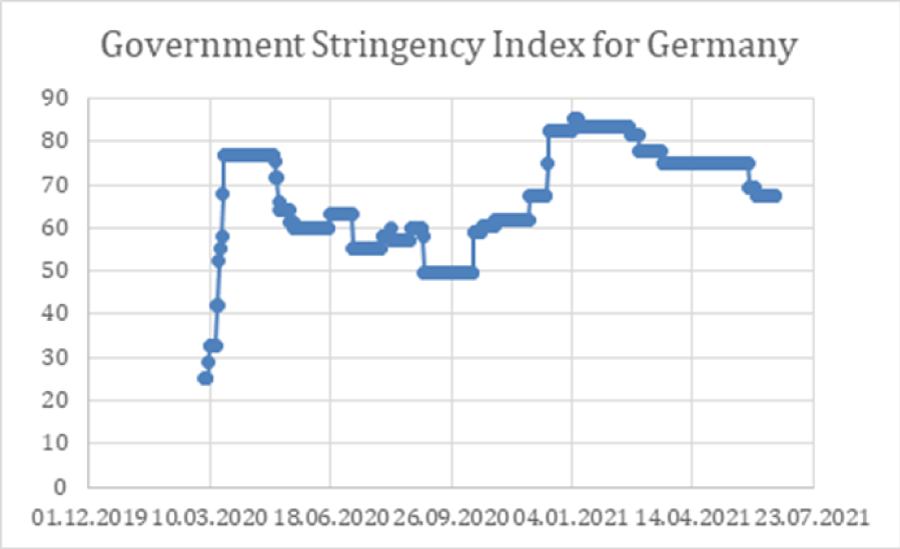 Figure 1: Government stringency.
View Figure 1
Figure 1: Government stringency.
View Figure 1
Restrictions were ramped up quite rapidly to a high level during the first lockdown and then relaxed over the Summer months, only to be reintroduced at an even higher level during the winter of 2020/2021 in the “second wave”. The stringency then remained quite intrusive through the Summer of 2021. Some mean descriptives of the period can be found in Table 2.
Table 2: Stringency characteristics. View Table 2
Public mobilities measured in percentage change from the baseline in the six categories (Table 1) are in Figure 2.
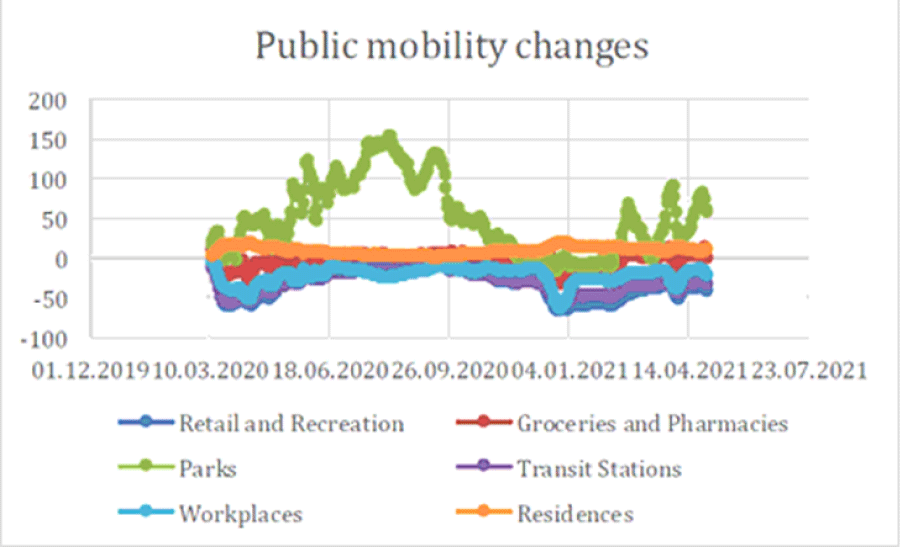 Figure 2: Public mobilities.
View Figure 2
Figure 2: Public mobilities.
View Figure 2
Activity at workplaces, retail and recreation, and public transit stations was well below ordinary levels through the period, while parks rose during the Summer and residential mobilities were constantly higher due to more work-from-home arrangements. Some overall characteristics of each type of mobility in the studied period can be found in Table 3.
Table 3: Aggregated changes in public mobility. View Table 3
Park mobility increased compared to the Winter baseline, while retail and transit stations were the most reduced. Mobilities in residence and grocery/pharmacy areas remained unchanged.
To compare the efficiency of the implemented policy measures and evaluate what sectors had the most impact on virus propagation, an attempt to quantify the association between government stringency, R-value, and each of the six mobilities. Spearman correlations between daily values of overall stringency, R-value, and public mobilities were calculated and presented in Table 4.
Table 4: Correlational analysis between mobility and Stringency with R values. View Table 4
It was found that a higher amount of stringency had the strongest negative impact on mobility in the retail (-0.85) and transit (-0.83) sectors, while more restrictions also were associated with more time spent at home (0.75).
The clearest associations were again between mobilities in the retail (0.45) and transit (0.42) sectors, respectively, where increased levels of mobility led to higher R-values. More time spent in the residence slowed virus reproduction (-0.27), while especially parks and workplaces had a rather small impact.
An evaluation of the model fit of GPR on the test set is presented in Table 5.
Table 5: Gaussian prediction statistics. View Table 5
The GPR with an exponential kernel captures the modelled relationship more accurately than the conventional method, as it leads to a closer fit and lower prediction errors, along with a coefficient of determination above 80%.
The reproduction rate was associated primarily with variations in mobilities for i) retail and recreation ii) transit stations (Table 3). Building upon the linearity of these two factors, it was possible to estimate the probability for an R-value under one based on retail mobility, in Figure 3.
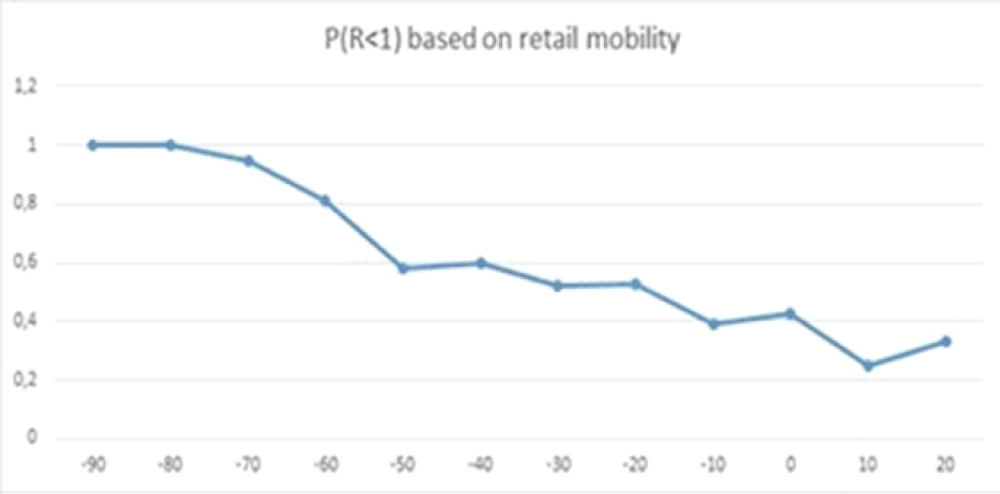 Figure 3: Estimated probability of R below spread levels based on retail mobility.
View Figure 3
Figure 3: Estimated probability of R below spread levels based on retail mobility.
View Figure 3
The graph indicates a 30% reduction of mobility as necessary for a higher than 50% probability of R being below 1.
The highest correlation between mobility and reproduction was identified for retail and transport, as these sectors seem to be the most pivotal for containing the virus [17,21,37]. Meanwhile, the lowest correlation between mobility and reproduction was found in the case of parks, work offices and residencies [37].
It was expected that higher mobilities would lead to more reproduction [21,38]. The negative association with temperature was also in line with anticipations, as the virus is known to spread at higher rates in lower temperatures [39,40]. As indicated by the high rise in park mobility in the Summer months, people were also spending a higher share of their time outdoors during warmer periods, making them less prone to infect others. The same results were discussed by Johnson, et al. [41] who found that spending time in parks can significantly lower transmission rates of COVID-19, however, a significant pattern was found in rural parts. The observed pattern should fit in spaces with fewer “green” areas.
Similar suggestions were found by Venter, et al. [42] who identified that increased mobility in blue areas (national parks, parks, natural areas) does not predict higher COVID transmission rates. June 2021 served as an example. Higher correlation between activity at retail/recreation and transit locations and virus propagation points to public transport, workplaces and cultural meeting points as areas of high importance for mitigating the pandemic. It appears that the German official strategy to contain these by closing a large number of cultural and recreational establishments and reducing utilization of public transport through stay-at-home orders was well-founded, while activities at workplaces, parks, and grocery stores had less impact. The targeted level of 30% should serve as a benchmark threshold for necessary mobility reductions in future similar outbreaks.
The goal of restricting community spread by containing R-values below one with at least 50% chance required a reduction of 30% in retail or transit mobilities, similar to previous results. Oh, et al. [43] concluded that mobility restrictions were the most effective during the early phase of the pandemic, with a much smaller effect in the later phase. The effect could be further elaborated by the potential of social distancing fatigue [11,12] after the first wave of COVID. Our predictions are partially confirmed by authors who presented values of 20% - 40% of overall mobility reduction to achieve reproductive value below 1 [21,43].
Understanding the relationship between stringency, mobility, and infection rates was crucial for coping with the worldwide outbreak of COVID-19. Based on the analysis of German data for the period from March 2020 to July 2021, we conclude that: a) containing activity in the public transport and retail sector are the most effective measures for reducing the spread of the virus and b) a reduction of at least 30 % of mobilities compared to the baseline was required to keep the odds of viral spread in the favour of public health. While the study provides significant insights into government and mobility management, it is not without limitations. Future research could benefit from a more precise dataset in terms of sociodemographic status, and geographic location to capture a wider effect of stringency measures. In addition, these results still need to be confirmed beyond the German example, where other behavioural patterns might be more prevalent. Further comparative studies are needed to better and more sensitively capture the cultural, social, economic and health system characteristics of specific countries or regions.
None.
The dataset is publicly available. Author(s) won't provide the dataset for the exact reason.
The autor(s) declare(s) there is no conflict of interest.